19:00 Take-off
19:00 hrs: Take off from RAF Leeming
Flight from Leeming, to Acklington, on to Scampton, and then back to Leeming.
We cannot know, but assume, that the sortie went as planned with the aircraft executing its flight as planned. However all we really know is that the air raft is not seen or heard from until it makes co tact with the approach control some time later…
20:00
20:00 hrs: WD788 calls Air Traffic Control at the appointed time. This is the last contact anyone has with the crew. The only certainty we ha e at this stage is that the aircraft is within radio range of RAF Leeming.
At this point the crew are faced with a dilemma. Without any possibility of descent through the cloud, the pilot must decide a course of action.
Both crewmen will be aware that they are supposed to bale-out. But they will also be aware of the enormous risk this poses.
Ultimately the decision is the pilot in cammand’s to make. They decide to remain airborne and use their remaining fuel to look for other options.
The Meteor is fitted with two 10 channel radios with preset frequencies set on each one. This limits the option s for raising assistance as there would only likely be a su set of these channels that would be of any help.
Question: who sets the radio up? RT failure was assumed as the cause of the accident.
20:30
20:30 Estimated depletion of fuel reserves
The aircraft systems would have failed as each engine depleted its fuel supply:
“port pneumatics, starboard hydraulics” p. 163 “The Meteor Boys” Steve Bond.
Without hydraulics the aircraft would not be able to operate: flaps, airbrakes, undercarriage or the windscreen wiper. Without pneumatics the wheel-brakes would not work. However the gear can be raised or lowered by hand pump after making the normal gear selection [1]
[1] POH pp16 – 19
The Meteor also features a vacuum system supplied by pumps on both engines. And two 3 kW electrical generators that charge the two series connected 12V batteries to generate 24 V. It is not known how long these systems would last in the event of engine failure.t
The electric Compass does have an emergency supply as do the cockpit lighting systems.
Before crash landing the canopy can be jettisoned (POH page 62). The full checklist from the POH is given below:
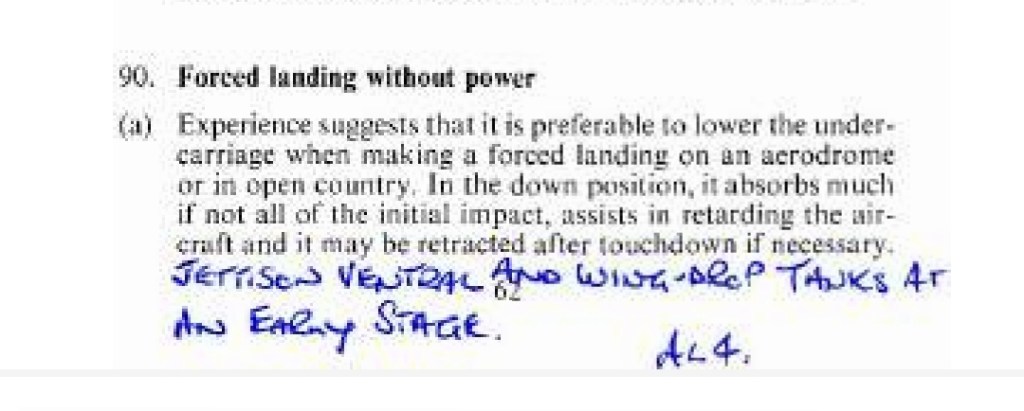
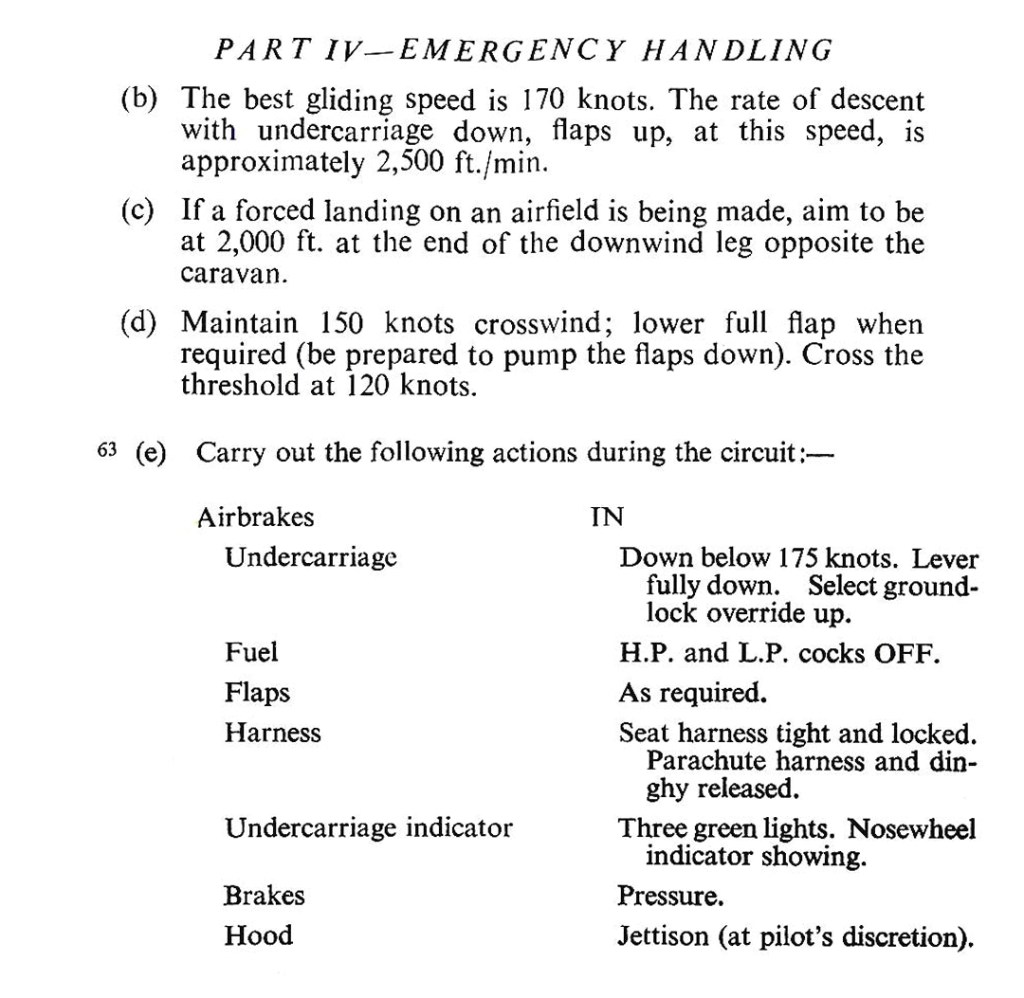
Importantly the best gliding speed for the meteor is 170 kts. At this spped the POH states that the rate of descent will be 2500 ft per minute.
20:45
20:45 Time of accident recorded in official report
 Gloster Meteor WD778