“I aligned the Meteor 8 for takeoff, applied the brakes, and checked that they held the aircraft stationary while the throttles were opened to give 11,000 rpm on each engine. Releasing the brakes, the throttles were opened fully and a quick check made of the engines’ speed – 14,550 rpm, jet pipe temperatures below 680 degrees Celsius, and fire warning lights out. The Meteor 8 accelerated rapidly and the nose wheel was eased off the ground at 70 knots, making sure not to hit the tail on the ground by raising the nose wheel too high. At 130 knots the Meteor flies itself off the ground. The undercarriage was retracted – before 175 knots, the flaps raised, and the climb began at 300 knots indicated airspeed with full power still set.”
from “How Meteors Hit the Ground (English Edition)” by Geoffrey Higges
“For take-off, I’d hold the brakes while setting 14100 rpm, release and finish pushing up to 14700 rpm. One of the critical items for these early jets is the safety take-off speed, or the minimum speed at which you can control the aircraft. With full rudder and a small amount of aileron, if you suffer an engine failure just after lift-off. For the meteor we use 160 kts. What this means is that at full power, below this speed, the jet has a tenancy to roll over on her back very low to the ground,which is less than ideal!
To mitigate this, we rotate at 125 knots, which has us in the ‘dead man’s curve’ for about four seconds.”
” After lift-off , we squeeze the brake handle to stop tyre rotation and select gear-up”.
Darren Crabb “The Meteor Boys” p. 195 Steve Bond
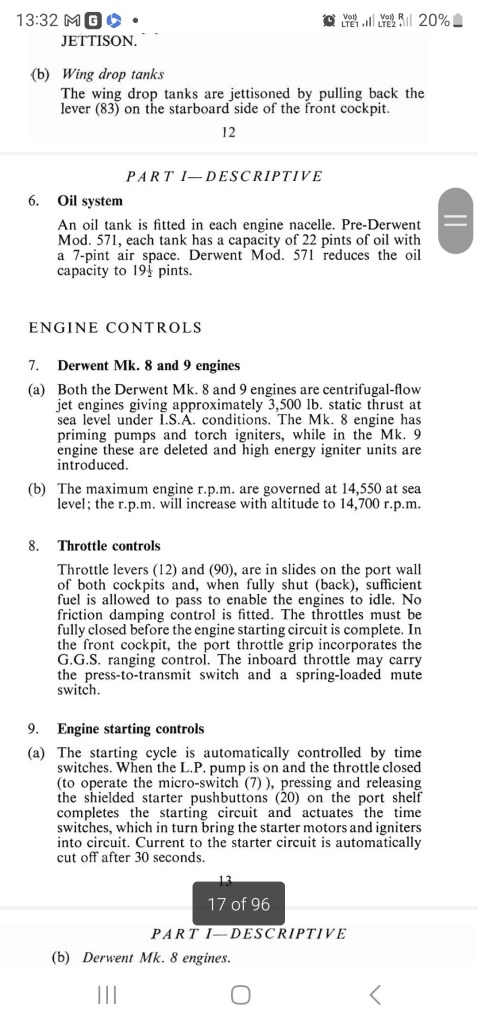
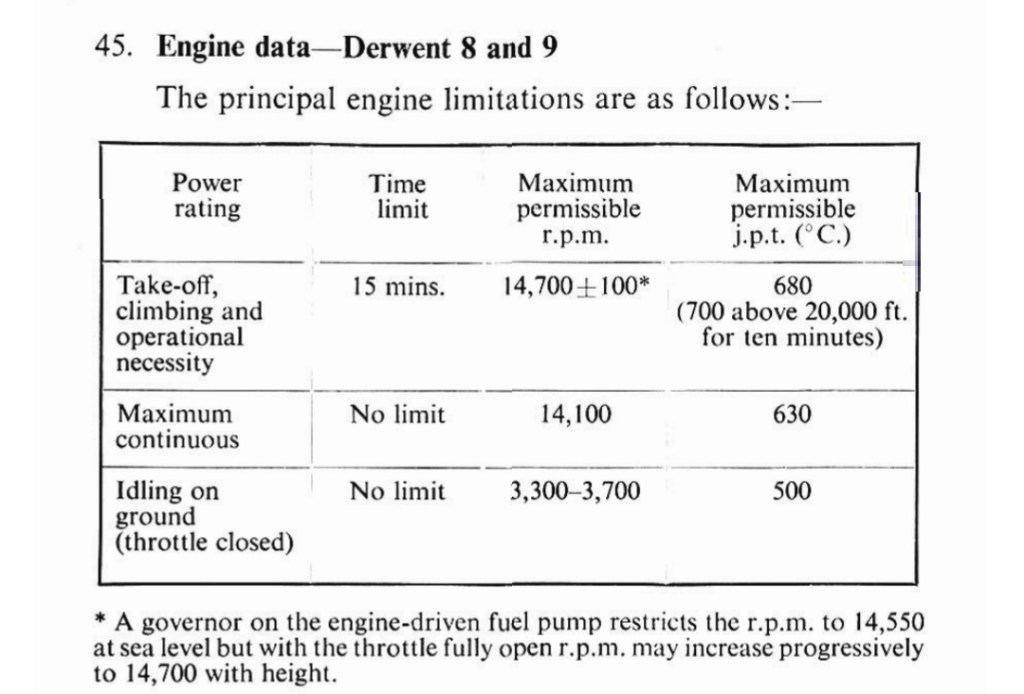
From the meteor pilots operating handbook, we can see that each account used:
Idle/brake check 11000 rpm = 75%
Run up check 14550 rpm = 98%
Hold off 14100 rpm = 96%
T/O 14700 rpm = 100%
 Gloster Meteor WD778