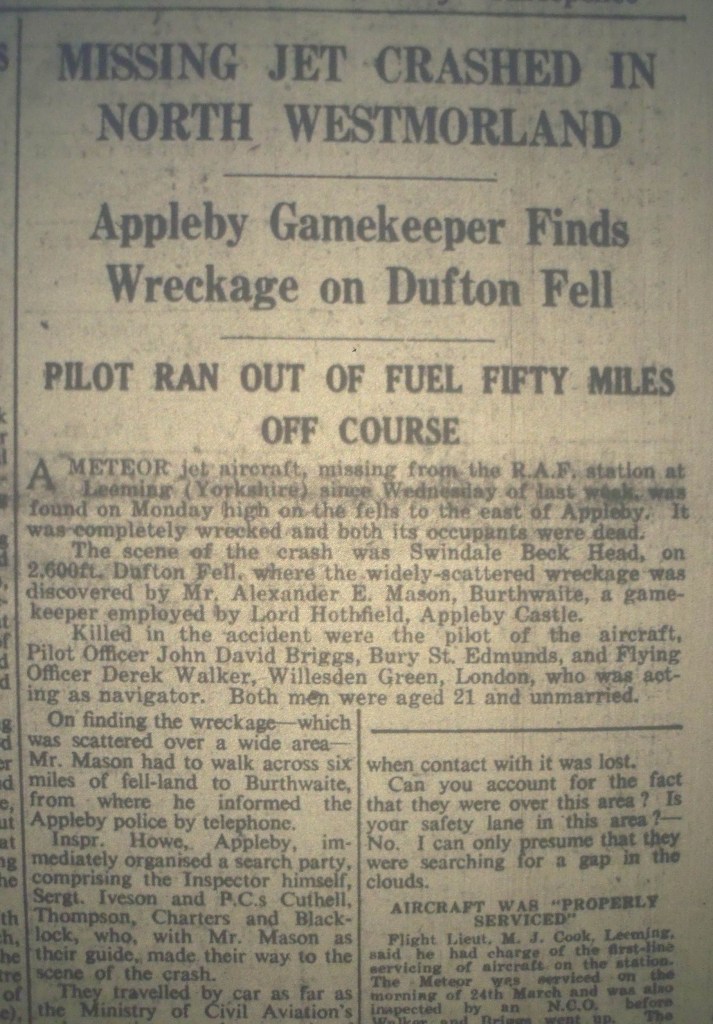
A meteor jet aircraft, missing from the RAF station at Leeming (Yorkshire) since Wednesday of last week as found on Monday high on the fells to the east of Appleby. It was completely wrecked and both its occupants were dead.
The scene of the crash was Swindale Beck Head, on 2600ft Dufton Fell, where the widely-scattered wreckage was discovered by Mr. Alexander E. Mason, Burthwaite, a game-keeper employed by Lord Hothfield, Appleby Castle.
Killed in the accident were the pilot of the aircraft, Pilot Officer John David Briggs, Bury St Edmunds, and Flying Officer Derek Walker, Wilesden Green, London, who was acting as navigator. Both men were aged 21 and unmarried.
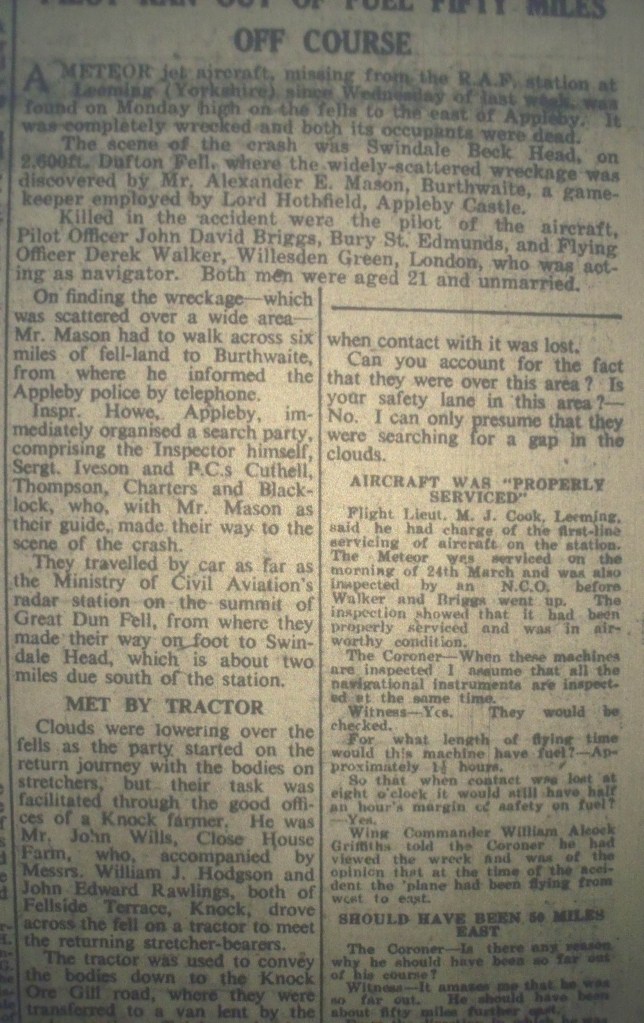
On finding the wreckage – which was scattered over a wide ares- Mr. Mason had to walk across six miles of fell-land to Burthwaite, from where he informed the Appleby police by telephone.
Inspr. Howe, Appleby, immediately organised a search parts, comprising the Inspector himself, Sergt. Iveson and PCs Cuthell, Thompson, Charters and Blaclock, who, with Mr Mason as their guide, made their way back to the scene of the crash.
They travelled by car as far as the Ministry of Civil Aviation’s radar station on the summit of Great Dun Fell, from where they made their way on foot to Swindale Head, which is about two miles due south of the station.
Met by Tractor
Clouds were lowering over the fells as the party started on the return journey with the bodies on stretchers, but their task was facilitated through the good offices of a Knock farmer. He was Mr John Wills, Close House Farm, who, accompanied by Messrs. William J. Hodgson and John Edward Rawlings, bth of Fellside Terrace, Knock, drove across the fell on tractor to meet the returning stretcher bearers.
The tractor was used to convey the bodies down to the Knock Ore Gill road, where they were transferred to a van lent by the radar station officials, and taken to the mortuary at Appleby.
The Inquest
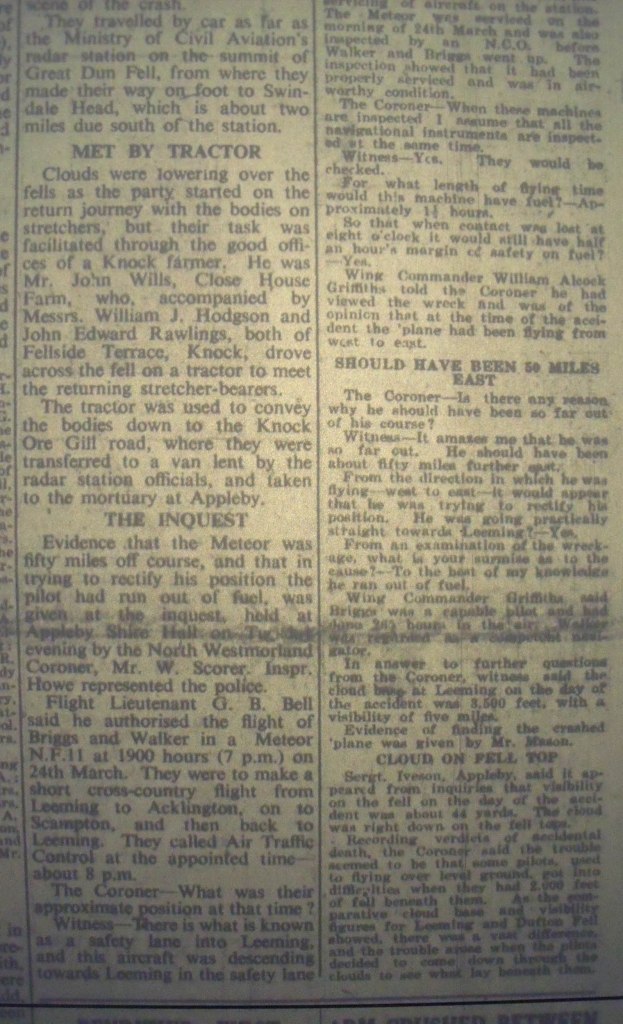
Evidence that the Meteor was fifty miles off course, and that in trying to rectify his position the pilot had run out of fuel, was given at the inquest, held at Appleby Shire Hall on Tuesday evening by the North Westmoorland Coroner, Mr W Scorer Inspr Howe represented the police.
Flight Lieutenant G B Bell said he authorised the flight of Briggs and Walker in a Meteor NF.11 at 19:00 hours (7 pm) on 24th March. They were to make a short cross country flight from Leeming, to Acklington, on to Scampton, and then back to Leeming. They called Air Traffic Control at the appointed time – about 8 p.m.
The Coroner – What was their approximate position at the time?
Witness – There is what is known as a safety lane into Leeming, and this aircraft was descending towards Leeming in the safety lane when contact was lost.
Can you account for the fact that they were over this area? Is your safety lane in this area? – No, I can only presume that they were searching for a gap in the clouds.
Aircraft was Properly Serviced
Flt Lt M J Cook, Leeming, said he had charge of the front-line servicing of the aircraft on the station. The aircraft was serviced on the morning of the 24th of March and was also inspected by an NCO before Walker and Briggs went up. The inspection showed that it had been properly serviced and was in airworthy condition.
The Coroner – when these machines are inspected I assume that all the navigational instruments are inspected at the same time?
Witness – Yes. They would be checked.
For what length of time would this machine have fuel? – Approximately 1 ½ hours.
So that when contact was lost at eight 0’clock it would still have half an hour’s margin of safety on fuel? – Yes.
Wing Commander William Alcock Griffiths told the coroner he had viewed the wreck and was of the opinion that at the time of the accident the plane had been flying from west to east.
Should have been 50 miles East
The Coroner – is there any reason why he should have been so far out of his course?
Witness – It amazes me that he as so far out. He should have been about 50 miles further east.
From the direction in which he was flying – west to east – it would appear that he was trying to rectify his position. He was going practically straight toward Leeming? – Yes.
From an examination of the wreckage, what XXXX your surmise as to the cause? – To the best of my knowledge he ran out of fuel.
Wing Commander Griffiths said Briggs was a capable pilot and had xxxx 285 hours in the air, Walker was regarded as a competent navigator.
In answer to further questions from the Coroner, witnesses said that the cloud base at Leeming on the day of the accident was 3500ft, with a visibility of five miles.
Evidence of finding the crashed plane was given by Mr Mason.
Cloud on Fell Top
Sergt. Iveson, Appleby said it appeared from inquiries that visibility on the fell on the day of the accident was 44 yards. The cloud was right down on the fell tops.
Recording verdicts of accidental death, the Coroner said the trouble seemed to be that some pilots, used to fling over level ground, got into difficulties when they had over 2600ft of fell beneath them. As the comparative cloud base figures for Leeming and Dufton Fell showed, there was a vast difference, and the trouble arose when the pilots decided to come down through the clouds to see what lay beneath them.
 Gloster Meteor WD778