WD788 Set out from RAF Leeming and was lost trying to recover to the same airfield later that night. The image below shows the approach plate for the QGH approach that the crew would have attempted to make on that night given the Northerly wind.
In understanding the fate of the aircraft, understanding what happened in this final crucial phase of the flight is key.
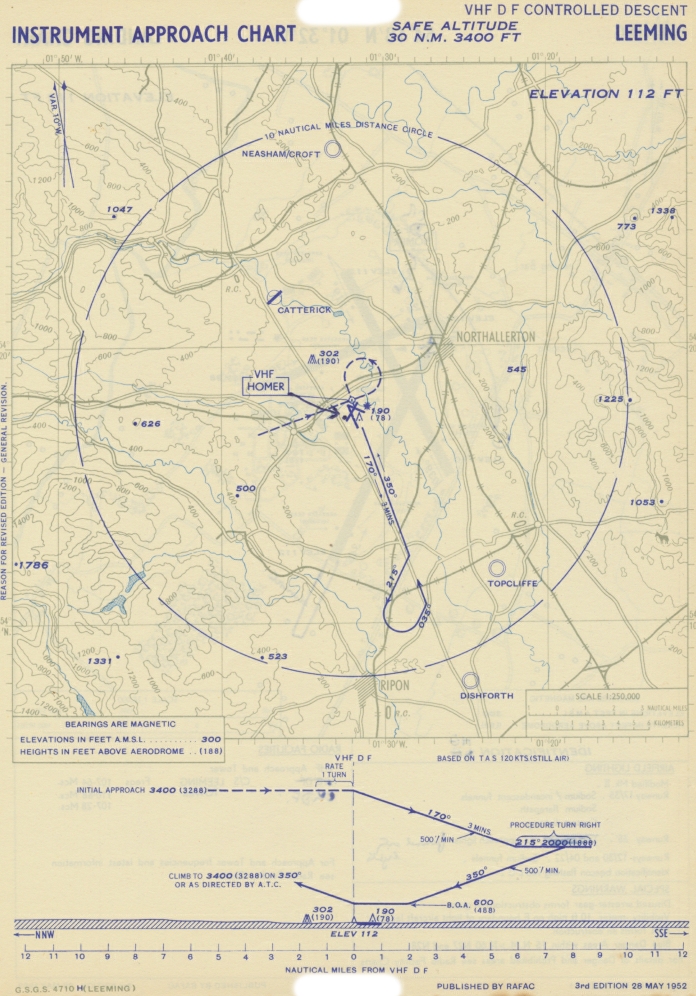
The instrument approach procedure shown above is reproduced from atchistory.
Before arriving at the station contact would have been made with the approach controller on a specific frequency. Once cleared to initiate the approach, several phases of flight and precise verbal instruction from the controller follow:
1) The first is arrival at the DF Station at a height of 3400 ft MSL. The QGH approach then relies on the controller to let the aircrew know that they are overhead and the DF direction indication flips.
2) This is followed by a lefthand rate-1 turn from the inbound direction, to heading 170 at which point the aircraft will pass overhead the DF Station again. Upon passing overhead, again, the controller must inform the aircrew as so that they may commence their descent.
As is made clear in other first-hand accounts of QGH approaches, it is at this point that the aircraft is in the safety lane. This is also mentioned in the inquest.
3) The first descent phase is made at 500ft/min – assuming that the aircraft is travelling at 120 kts TAS. The rate of descent and duration of the descent would be modified for other speeds and the speed and direction of the wind. The descent is made for 3 minutes at 120 kts.
4) Once the first descent has reached 2000 ft MSL, the pilot then makes a procedure turn. This is still used today in instrument approaches. The turn starts with a turn to 215 degrees. This course it held for 1 minute and is followed by a rate 1 turn back to the reciprocal heading (in this case 035 degrees).
5) The terminal phase of the approach is another descent at 500 ft per minute, this time on a heading of 350 degrees. This final descent is made to the minimums for the approach. This appears to be 600 ft MSL (448 ft AGL). These minimums would be adjusted by the proficiency of the pilot. (In the case of Briggs, with a white instrument rating, 200 ft would be added to this.
Once sighted the final approach would be made, for this approach runway 34 (with a heading of 338 degrees) would have been slightly offset. This is also perfectly normal in modern non precision approaches. This phase of the flight is made ‘without further assistance’.
Open Questions
Would the meteor make this approach at 120 kts?
What would likely diversion airfields have been and which, if any, may have had clearer weather? A list of other possible military diversion fields can be found at wikepedia.
 Gloster Meteor WD778