What is the QGH Approach Procedure
The QGH approach allows a single direction finding receiver station to direct an aircraft along a safe descent route through cloud. With no information on the distance from the station the QGH approach procedure relies on an overflight of the direction finding station and then careful timing of the subsequent steps.
The procedure is outlined in the following period film from the Australian War Memorial, explains this non-precision approach procedure that ultimately relies on the controller to guide the aircraft descent through cloud and the pilot to perform a final visual approach once below the cloud base.
Excerpt: The Approach
The Safety Lane
Some really interesting supplemental information on the QGH/GCA approach (noted in the formal crash report) sheds some light on how these approaches were really performed, and the duties of the approach controller:
He was responsible for aircraft flying outside the three mile radius of the airfield and his main task was informing pilots which way to steer their aircraft to reach the overhead by passing to them over the R/T the bearings presented to him on the CRDF indicator. Once overhead the pilot was given a predetermined course to steer. This heading was known as the ‘safety lane‘ and was in a direction free from hills and other airfield lanes. Once established on this heading a pilot was told to commence descent to around half his starting height. When he reached this low level, he was instructed to turn onto a reciprocal heading and then descend to 2,000ft. This procedure brought the aircraft safely down through cloud and in visual contact with the airfield.
Guy Jefferson, from airfieldresearchgroup.co.uk
This mention of the safety lane, describes a specific portion of the approach, namely the point from which the procedure turn was complete and the descent had begun.
QGH Approach Procedure Today
The QGH approach is a special kind of VDF (VHF Direction Finding) approach [1]. In a VDF approach the controller provides QDM (magnetic bearing to the station). A good illustration of what a VDF approach looks like today, and the accompanying radio procedure, is given in the following video.
The QGH approach follows the same procedure, but also includes guidance from the controller on the headings to steer, rather than just the QDM, accompanied by descent instructions [1].
Flying the Approach
When flying a QGH or VDF approach the controller is responsible for giving instructions to the pilot, who in turn is responsible for their execution.
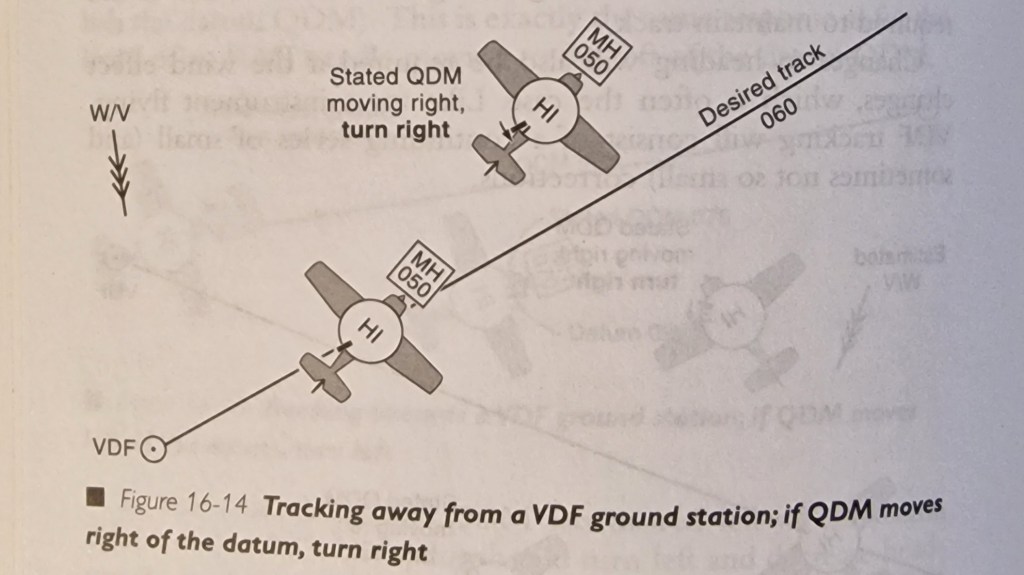
The only exception to this is the compensation for wind. In the case of a head or tailwind, only the influence on speed must be calulated.
In the presence of a crosswind, the pilot needs to calculate and compensate the heading modification. Where the wind is unknown the correct track is determined by bracketing.
Resources
- The approach procedure for RAF Leeming
- Read Guy Jefferson’s full account at airfieldresearchgroup.co.uk
References
[1] Trveo Thom, The Air Pilot’s Manual Vol. 5, Radio Navigation and Instrument Flying for the PPL. 4th Edition 2001,Airlife England, pp 315-328
 Gloster Meteor WD778