VRIAB
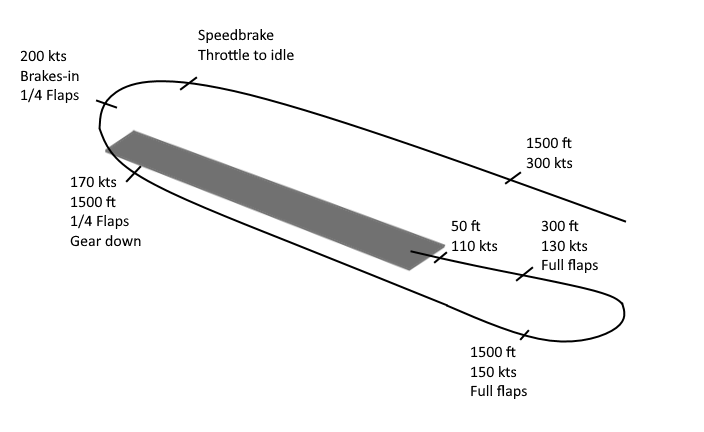
Accounts from meteor pilots indicate that something similar to the Visual Run In and Break (VRIAB) used in modern airforces was also used in the 50’s. The run in and break is used when the airfield can be seen and is a fast way of recovering multiple aircraft in hostile environment.
Initial/Join
In VFR conditions the initial call to the approach controller is made. Today this would be make at the pattern height, which for the meteor was 1500 ft and we infer a speed of 300 kts based upon modern practice.
“Normally you are at a downwind position parallel to the runway at 1500 feet for a standard landing procedure”
(from “How Meteors Hit the Ground (English Edition)” by Geoffrey Higges)
The Break
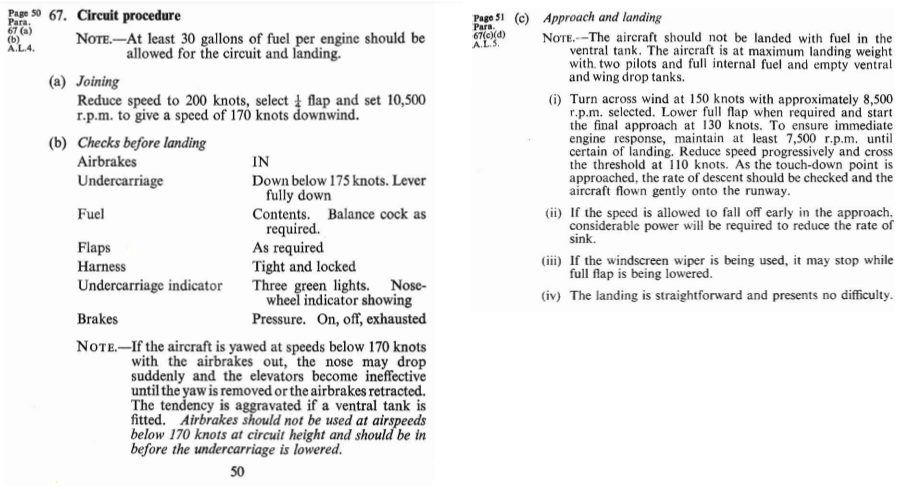
During the break speed is bled off whilst maintaining pattern altitude to get the aircraft slow enough to configure. This was done in the meteor by also employing the speed brake, although care had to be taken to ensure the brake was in before lowering the gear.
find ref for gear
Downwind
The downwind leg is made at 150 kts, with 1/4 flap and the gear deployed.
“In fact the downwind checks and aircraft speeds of 150 knots downwind and 130 knots final approach were hardly changed from normal, … 8,000 rpm for a normal approach.”
(from “How Meteors Hit the Ground (English Edition)” by Geoffrey Higges)
But the thing that was banged into you was that you’d got to be downwind to land with 40/40 or whatever the gallon age was because the meteor drank fuel like it was going out of fashion.
Robin Chandler, “The Meteor Boys” p. 158 by Steve Bond.
Finals
The aircraft should tip in for finals at 150 kts. Halfway through the turn, the altitude should be 900 ft and the airspeed should be coming down through 140 kts.
Once established 1 mile from the runway the meteor should be at 300ft, 130 kts and full flaps.
The aim is to cross the threshold at 50 ft, bring the throttle to idle and touch the rear wheels down first. Taking care not to strike the tail.
 Gloster Meteor WD778