The radar on the meteor was designed for detection of aerial targets and was a version of the SCR-720 radar which equipped fighters during WWII. This radar was designated the APS Mk X. The performance was limited:
We had the APS Mk-10 radar in the NF.11, which had a nominal range of five miles – you could usually reckon to get 2…
Peter Bogue, chroniced in ‘The Meteor Boys’ p82, Steve Bond
The video, below from the archives of the Imperial War Museum gives an excellent overview of the radar’s helical scan pattern. It also reveals that the scan elevation bounds could be set by the operator. Extending to a depression of 20 degrees.
In our case, the air-to-air performance of the radar is not our main interest, instead – was the radar used in an air-to-ground capacity for navigation? The answer to this is hinted at in the crash report of the RAF.
“From the evidence available it is assumed that the aircraft suffered complete R/T failure at the time contact was lost and the pilot climbed to a safety height of above cloud and attempted to establish his position by radar/radio aids and by looking for a break in the cloud until the a/c ran out of fuel.”
RAF Form 1180
The inference is that, due to the lack of possible communication, this refers to airborne radar navigation. Further investigation, from the same IWM archive shows that trials were performed using this radar in this role.
This is confirmed in the contemporary Air Ministry publication, which shows the use of the radar’s B-scope for the detection of terrain features.
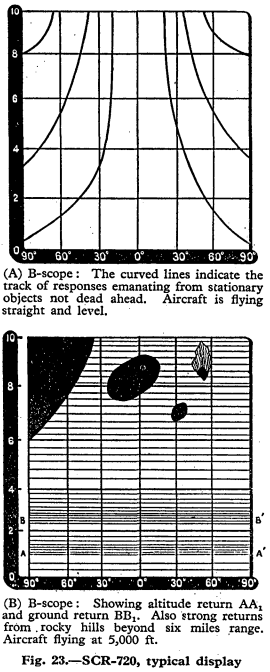
Whilst we can never know if the radar was operational in the lead up to the accident, we can conclude that, had it been, it could have been used by the crew as a navigation aid.
| Wavelength | 10 cm |
| Pulse width | 0.75 microseconds |
| Pulse repetition frequency | 1500 Hz |
| Scan rate | 360 rpm (ranges below 100 miles) 100 rpm (at 100 mile setting) |
| Power | 3 kW |
| Range | Bombers at 10,000 feet (3000 m): 10 miles (16 km) Fighters at 17,000 feet (5200 m): 5 miles (8 km) Minimum 250 feet (75m) |
| Antenna | 29″ (74 cm) parabolic |
| Scope | Operator: 5″ (12.7cm) B scope 5″ (12.7cm) C scope Pilot: 3″ (7.6 cm) B or C scope |
| Accuracy | 3 degrees |
| Weight | 412 lbs 187 kg |
| Production | In production by 1944-5 |
References
Links:
https://www.qsl.net/pe1ngz/airforce/airforce-raf/raf-interception-radar.html
http://www.ibiblio.org/hyperwar/USN/ref/NightFighterRadars/index.html#SCR520
 Gloster Meteor WD778