Almost a year after the incident involving WD778, in January 1955 a similar incident was reported by the crew of an NF. 14. Unable to descend through cloud due to communication problems, they eventually established communication with RAF Odiham approach. Unfortunately, another aircraft was blocking the runway after a heavy landing, forcing the aircraft to go around.
“I climbed to 1500 feet, leveled out, noting that the fuel gauges showed empty, and told the navigator to prepare to abandon the aircraft”.
Mike Kemp, from The Meteor Boys, by Steve Bond
This period video shows the development of the first ejector seats. Sadly, the NF.11 was one of the last RAF aircraft that required the aircrew to bale out in the event of an emergency. The first 2 minutes of this film illustrate the difficulty the crew would have escaping the aircraft.
https://film.iwmcollections.org.uk/record/775
Baling Out!
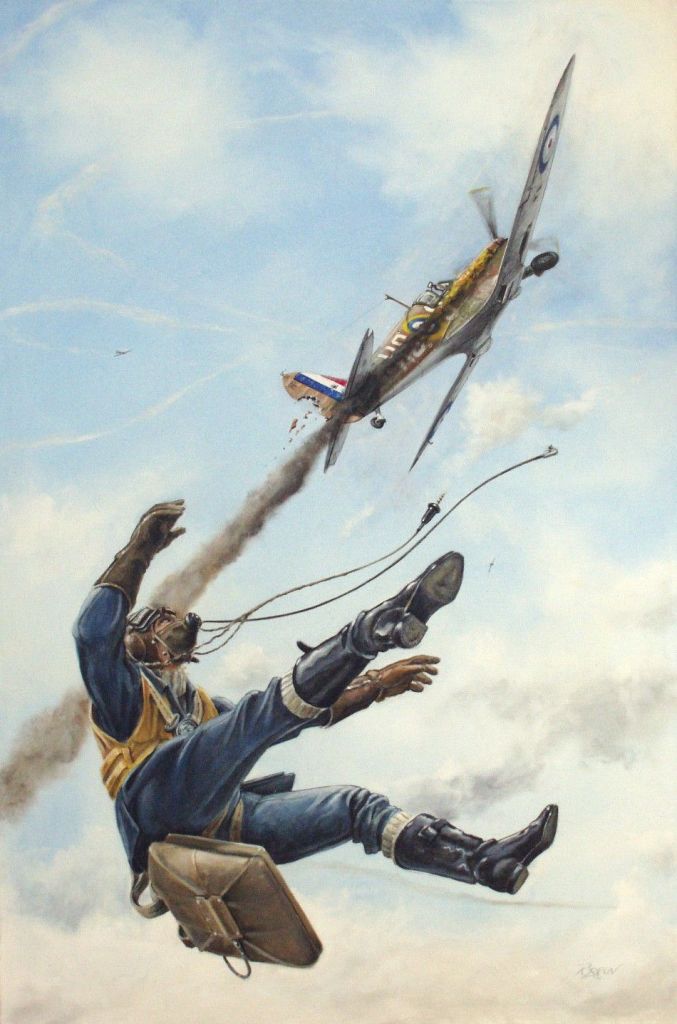
The procedure for abandoning the NF.11 belonged to the same wartime practice of manually opening the canopy and jumping from the stricken aircraft.
Whilst suitable for the slower propeller and piston engine aircraft of the second World War, the jet age had ushered in with it, speeds that made baling out much more dangerous and, in some cases, physically impossible.
I did not fancy bailing out as the F4, which had no ejection seat, had a very high tail and pilots had collided with it trying to escape the machine. Whilst under training one of my fellow students had been killed trying to do just that.
Bill Gill, in The Meteor Boys p.148
Another Bale Out
This account details the crew abandoning their aircraft in late 1951, when an inverted spin was induced during aerobatics over 8/8 cloud:
When Hugh tried to leave, he dived over the port sid of the cockpit but the tail whipped round, and the leading edge of the tailplane gave him a mighty blow across the chest and broke his right arm. He saw a white flash, and for a moment thought his parachute had been ripped off. He fell free and as Peter was descending, still in the cloud, he was startled as Hugh passed him on the way down. They came out of the cloud and Hugh, at low level, at last managed to pull his rip cord, and to his surprise and delight his canopy opened. In a field near Barnard Castle a bull was laying ruminating, when Hugh ruined his day by landing right in the middle of his back. The incident was reported jn the Daily Express, and when I visited Hugh in hospital I asked if he had been scared. He replied, ‘I wasn’t but you should have see. The bloody bull’!
Wing Cdr. Brian Ashley, Meteor by Brian Philpot p 234
It is very likely that Briggs and Walker would have been acutely aware of the immense risk of bailing out of the aircraft and elected to stay with the stricken aicraft rather than bale-out.
 Gloster Meteor WD778